
Art at the Universidad Laboral de Gijón
The mural paintings of the Aula Magna of the Universidad Laboral de Gijón form the most significant pictorial ensemble of all those produced in educational buildings in Spain from the mid-20th century onwards
The commission for the murals was given to the Seville-born painter Enrique Segura in December 1952; the following year he practically finished and completed the mural of the frontispiece of the auditorium, which has since disappeared as a result of the remodelling carried out from 2005 onwards.
In 1954 he undertook the 450 square metres, of which only 300 were executed before the works were halted in 1957.
The extent of the sketches, some of which he made in the square of the Laboral itself, allowed the painter to make progress on the overall composition; Enrique Segura also travelled to various places in the Asturian region in order to capture the character that defined the life, customs and temperament of the people.
By 1956 Enrique Segura had executed five of the large panels planned, leaving two still to be completed, whose sketches are held by the Segura family and by the Asociación de Antiguos Alumnos: the so-called Allegory of the Effort of the Asturians and Allegory of Victory.
The great frontispiece mural in a photograph of 1952, before its completion
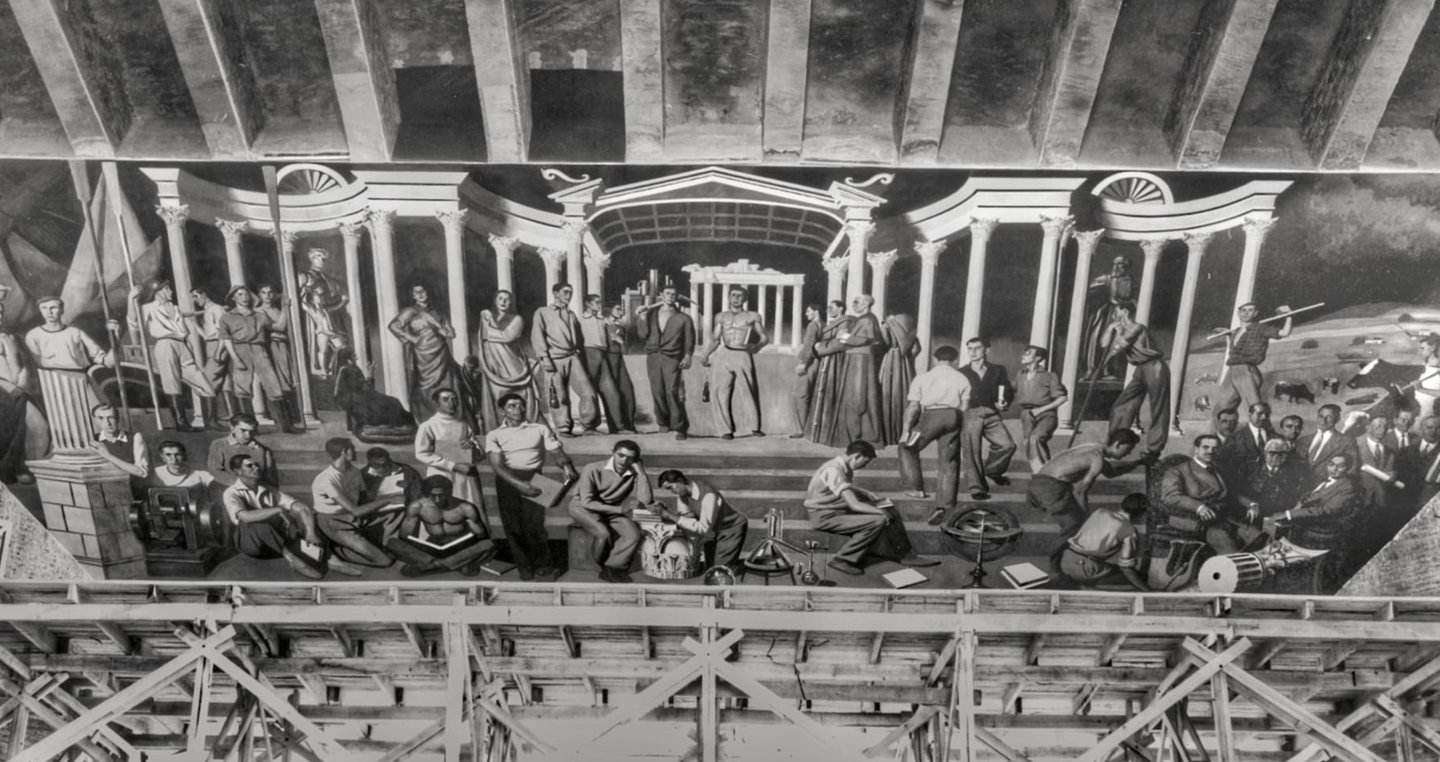
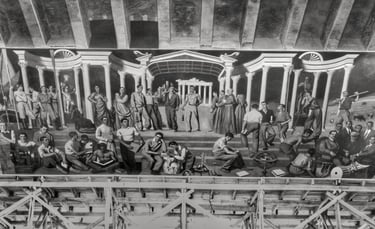
Original photograph of 1952, with the mural well under way and the platform from which the painter Enrique Segura worked
THE GREAT MURAL (FRONTISPIECE) OF THE AUDITORIUM, COMPLETED IN 1953
The theme of this painting is to express that the levelling of social classes is possible through education and culture
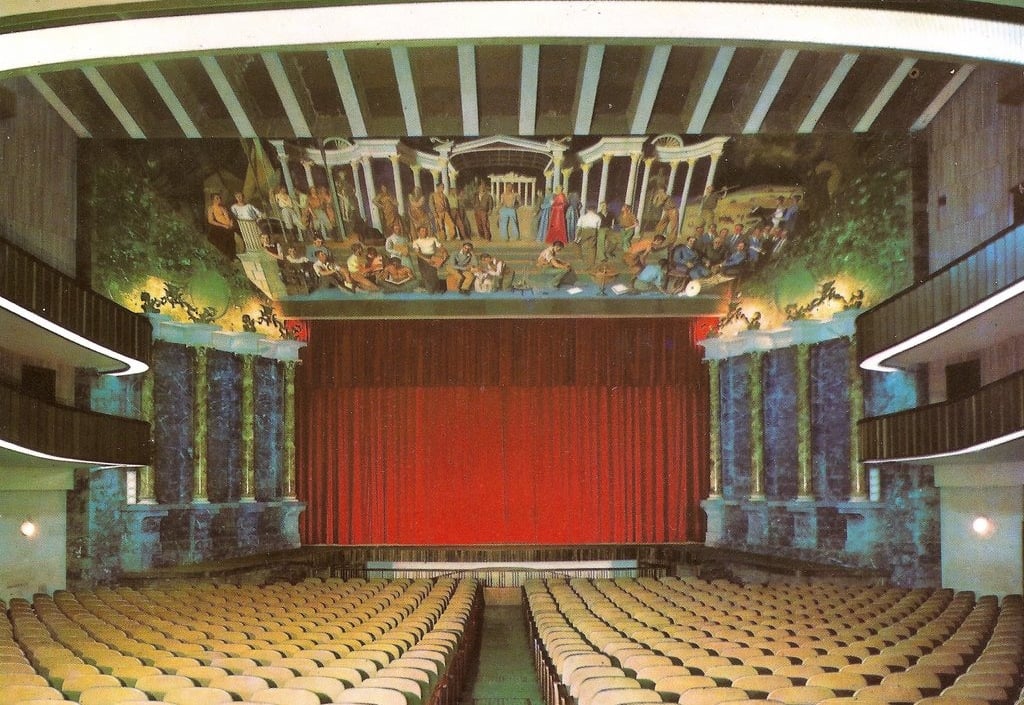
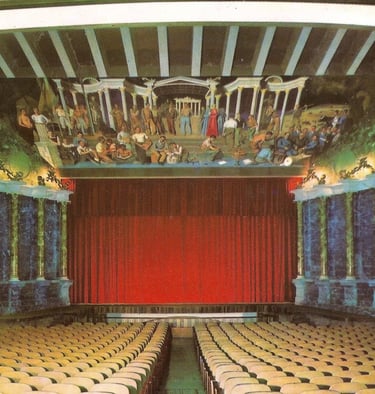
In this mural, farm labourers, seamen and workers from industry and mining lend the project an Asturian and local pulse, while the iconographic value of the composition is reinforced by the portraits of the project's main protagonists.
The definitive sketch was made on brown wrapping paper, to be transferred at a later stage to the wall surface by means of pouncing (stencilling). In late autumn 1953 Enrique Segura was still on the scaffolding finishing the work.
This allegorical painting moves within the orbit of the mural creations of some of the artists of the Italian Renaissance
THE UNEXECUTED MURALS
SKETCHES THAT REMAINED TO BE EXECUTED
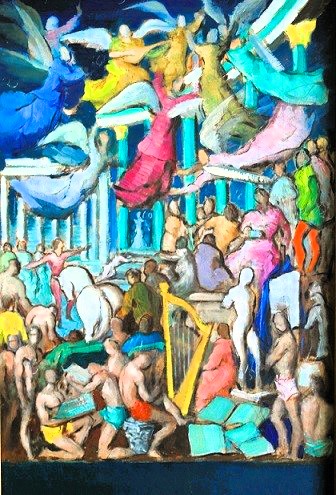
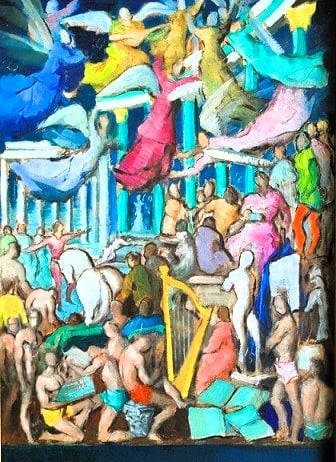
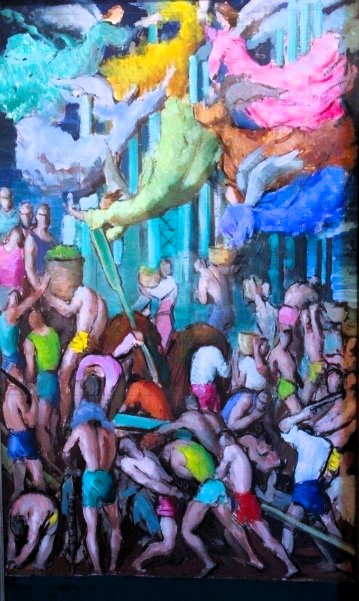
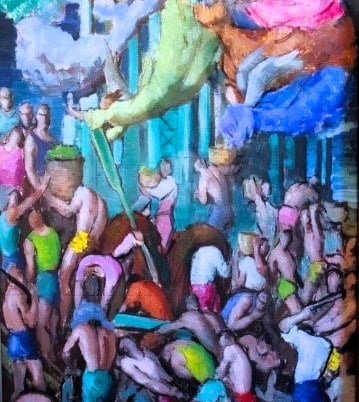
ALLEGORY OF VICTORY
ALLEGORY OF ASTURIAN EFFORT AND LABOUR
This allegory stands as a symbol of the knowledge and culture treasured by the new generations of young students striving for a more promising future.
A scene full of movement and theatricality, in which various figures of angels appear in a setting of classical and industrial architecture, together with workers
THE SET OF MURALS EXECUTED BY ENRIQUE SEGURA
MURAL PAINTING BY ENRIQUE SEGURA SYMBOLISING THE FOUNDING ORIGIN OF THE UNIVERSIDAD LABORAL DE GIJÓN
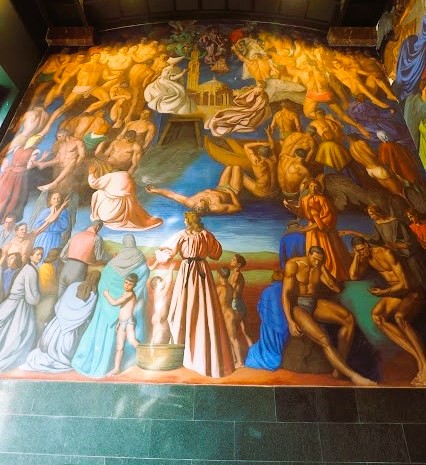
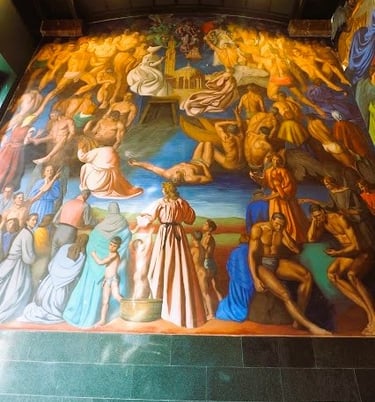
In this mural painting the painter Enrique Segura symbolises the main activities of Asturias at that time, mining and the sea, where accidents at work were very frequent. We therefore see two men carrying a miner, and a woman weeping over the injured body, emerging from a mine entrance located at the base of a building that is the Universidad Laboral, represented by the tower and the church; above is the Virgin of Covadonga, patron saint of Asturias, and beside her Saint Joseph the Worker. The nuns represent the Poor Clare sisters (housekeeping and catering) and the Servants of Jesus (nursing), and finally the angel represents the Jesuits, as the tutelary bodies of the Universidad Laboral.
To the right and left, young people representing students preparing for their professional and social future.
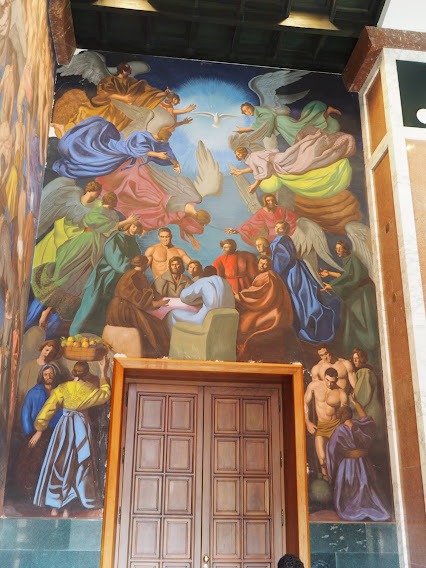
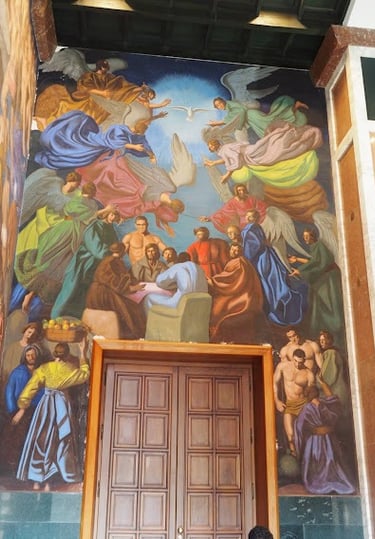
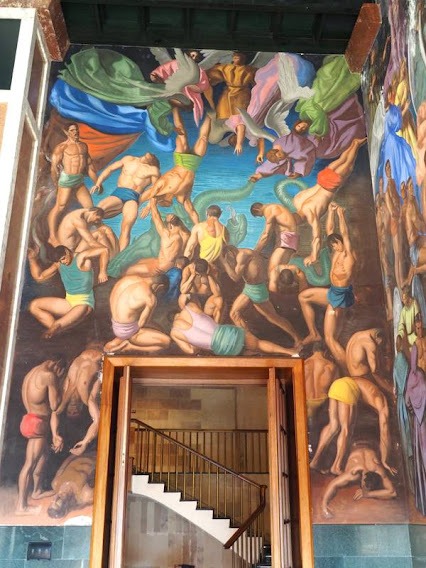
THE PATRONATO. This mural gives prominence to the founders and promoters of the institution. The painter takes as his source of inspiration the Gospel depiction of the Last Supper
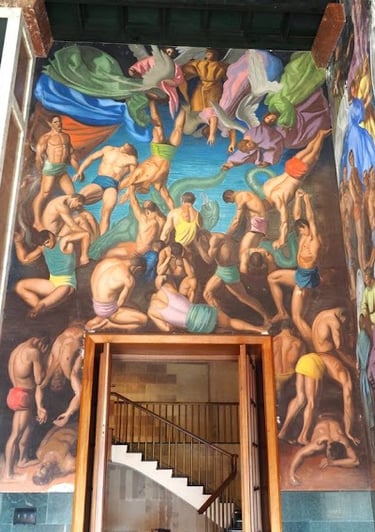
THE DEFEATED . This mural is related to the mural panel The Damned by the Italian Luca Signorelli, in Orvieto Cathedral (Italy).It is a creation in which the detractors are shown struck down by the forces of evil.
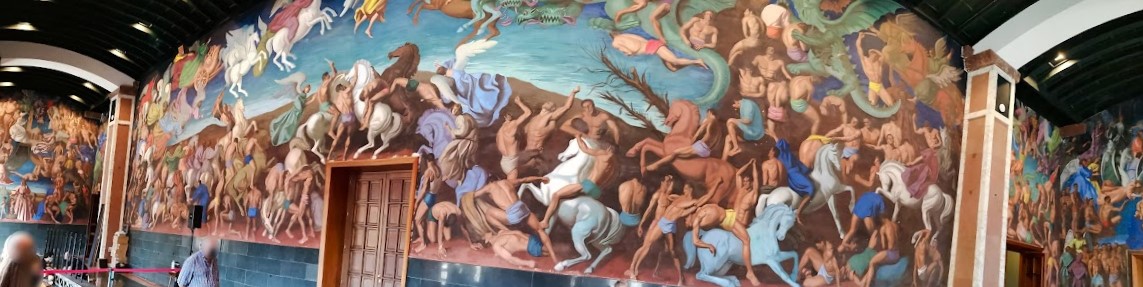
THE BATTLE
The struggle between good and evil.
This scene is interpreted as the effort and struggle needed to achieve professional success, a more or less hard-fought contest between strength and weakness of a spirit assailed by the enemies rooted in discouragement, inaction and ignorance
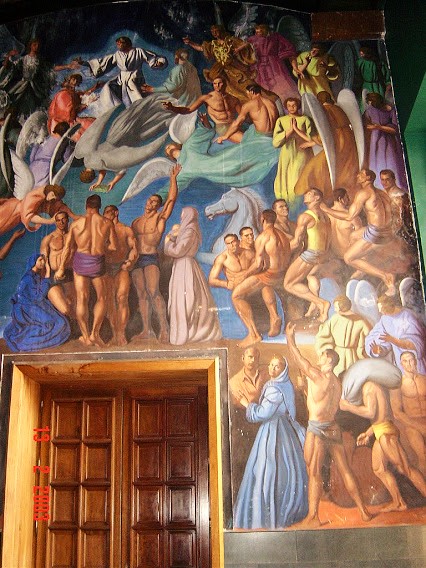
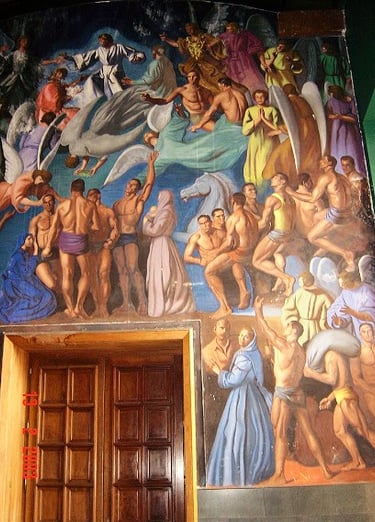
THE TRIUMPHANT.
This mural is inspired by Michelangelo's Last Judgement in the Sistine Chapel.
The composition is conceived in close-up, giving maximum prominence to figures that convey a life of their own, the same life displayed by the author, who portrayed himself together with his wife Cándida in the lower right-hand area
Rafael Morán Rumoroso
info@universidad-laboral-gijon.es

