In building the church at Gijón, the architect Luis Moya drew on the experience of the church of San Agustín in Madrid, built some years earlier. Moya used that church as a model, but gave the Asturian one larger dimensions to accommodate the number of worshippers. Luis Moya wrote that what was done in Gijón preserves all the classical elements: an altar under a baldachin, presbytery, triumphal arch, ambos, singers' choir, a broad nave and upper galleries.
As regards its relationship with the rest of the complex of the Universidad Laboral, the church occupies a prominent position
EXTERIOR FAÇADE OF THE CHURCH, WITH STEPS SIMILAR TO THOSE OF THE CERTOSA DI PAVIA.
THE CROSS-SHAPED IRON SUPPORT SEEN IN THE PHOTOGRAPH IS THE ONE THAT HELD THE VICTORY CROSS, WHICH WAS DISMANTLED IN 1998.

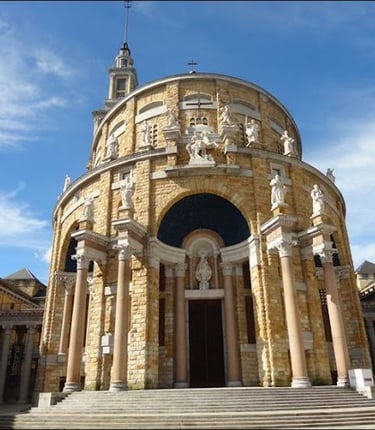
On the exterior there is a large sculptural ensemble, the work of Manuel Álvarez Laviada. It comprises the image of the Virgin of Covadonga above the lintel of the main door; those of Saint Joseph, Saint Paul, Saint Peter and Saint Ignatius on the four columns that flank it; that of Saint James on horseback above the great central niche of the façade; and above this, on the cornice itself, two angels adoring a reproduction of the Victory Cross.
Laviada's work continues with 16 more statues on the cornice, which are images of Spanish saints and of other educators.
The height of these figures ranges from 2.40 to 2.55 metres. They are of white Colmenar stone, which makes their graceful silhouettes stand out against the medium-dark colour of the sandstone and the granite.
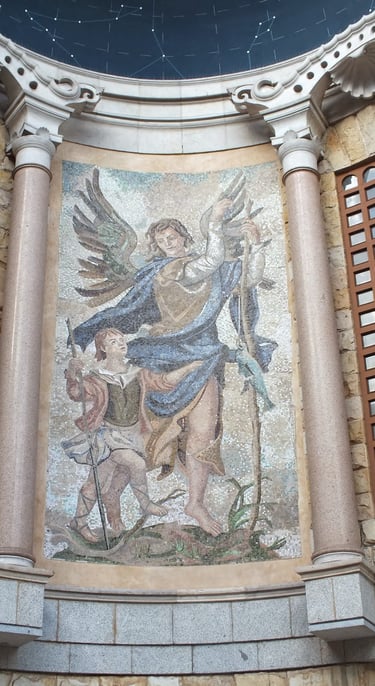
The large lateral niches on the exterior were to be faced with mosaic, being dedicated to the Archangels and the Evangelists.
SAINT JAMES ON HORSEBACK ON THE GROUND AND AFTER BEING RAISED TO ITS POSITION


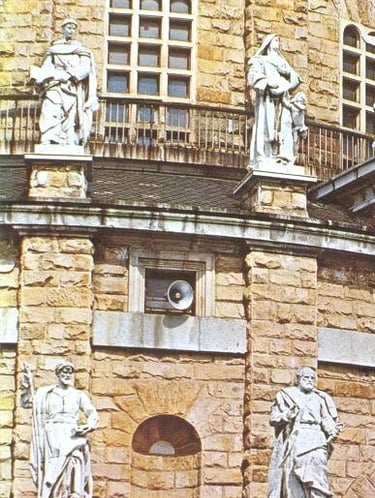
SECOND INSTALLATION OF STATUES
TWO ANGELS ADORING THE VICTORY CROSS, SHOWN ABOVE IN PLACE
Images of Saint John of the Cross, Saint John Bosco, Saint Vincent Ferrer and Fray Melchor de Quirós (an Asturian saint)
On this north façade are also the statues of Saint Clare, Saint Peter of Alcántara, Saint Lawrence and Saint Isidore
On the south façade of the church are also the statues of Saint Eulalia of Mérida, Ferdinand III the Saint, Saint Isidore the Labourer and Saint Toribio of Astorga
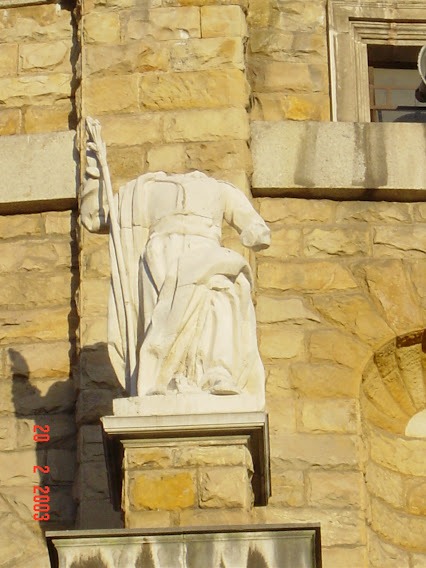
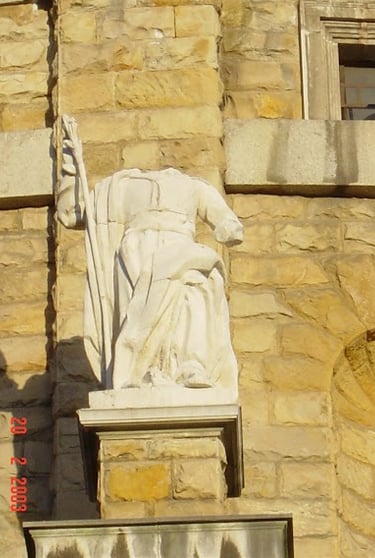
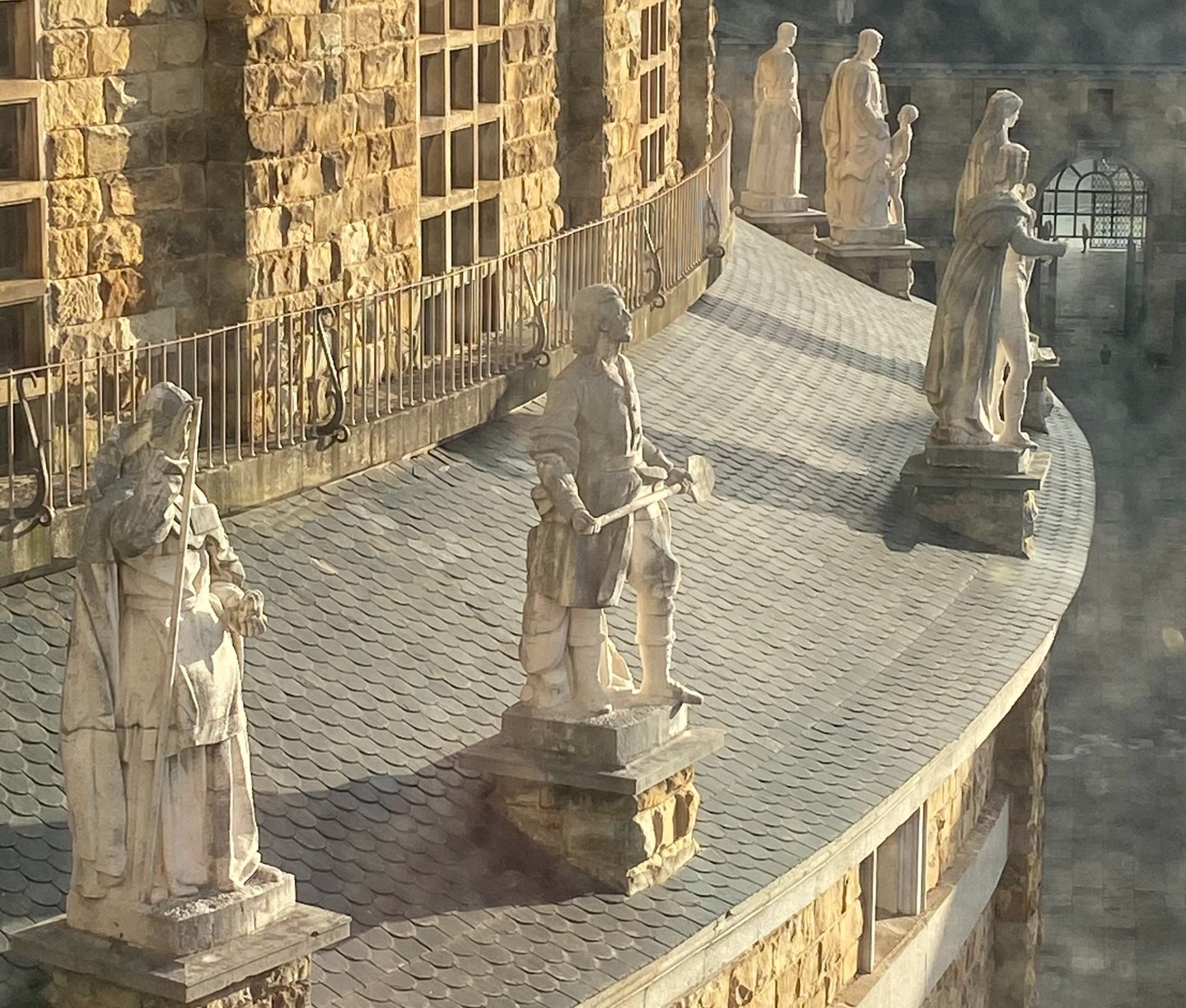
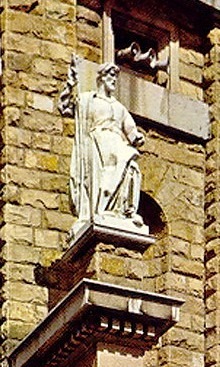
At the beginning of the 1990s, lightning struck the cross and the bronze ball crowning the church, bringing down part of the bronze ball, which rolled down the roof of the church and fell onto the statue of Saint Joseph the Worker, knocking off its head and the hand of its left arm. The upper left photograph shows the statue of Saint Joseph in its original state, and the lower ones the condition of the statue to this day.
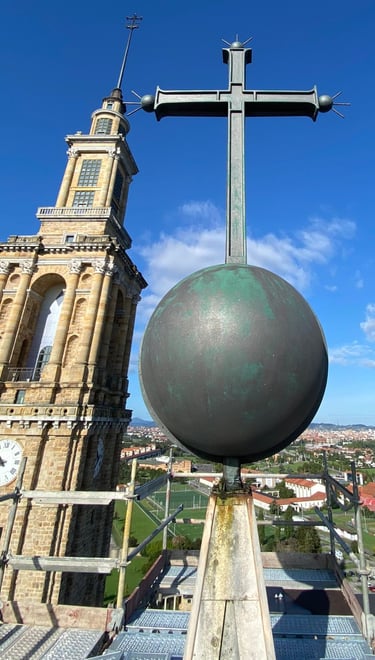

Ball and cross that replaced the one brought down by the lightning
On the south side, to our left (if we stand facing the church), the images of Saint Teresa of Jesus, Saint Dominic de Guzmán, Saint Francis and Saint Joseph Calasanz
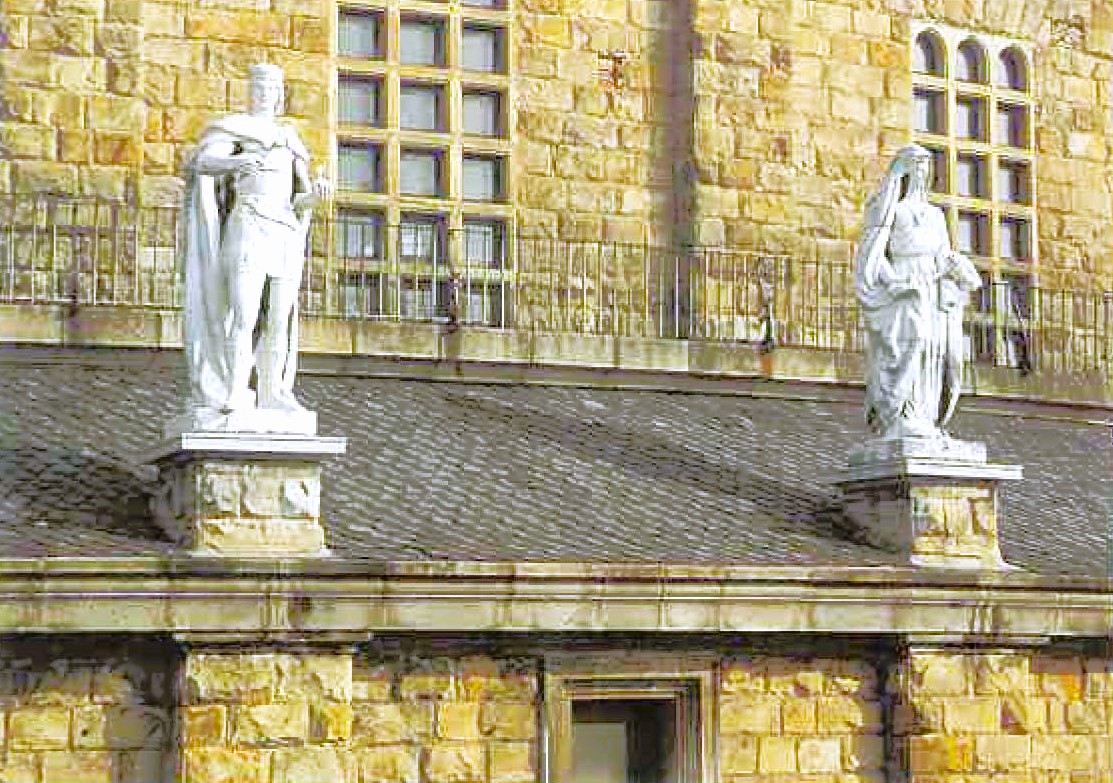
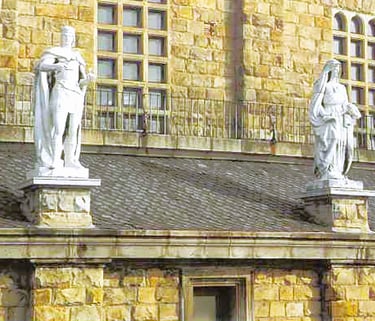
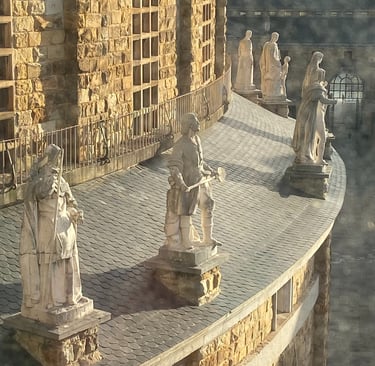
IN THE UPPER PHOTOGRAPH OF THE LEFT SIDE OF THE CHURCH WE SEE THE STATUES OF FERDINAND III THE SAINT AND SAINT EULALIA OF MÉRIDA.
IN THE LOWER PHOTOGRAPH, ON THE SAME SIDE, WE HAVE FIRST SAINT TORIBIO OF LIÉBANA, SAINT ISIDORE THE LABOURER, FERDINAND III THE SAINT, SAINT EULALIA
OF MÉRIDA, SAINT JOSEPH CALASANZ AND SAINT FRANCIS XAVIER.
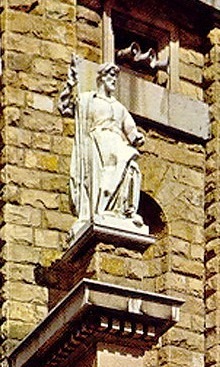
STATUE OF SAINT JOSEPH THE WORKER IN ITS ORIGINAL STATE, PHOTOGRAPH FROM THE 1960s
STATUE OF SAINT JOSEPH THE WORKER AFTER THE FALL OF THE BALL FROM THE CHURCH CROSS
The mosaics of the exterior niches of the church
The drawings for the exterior of the church are the work of the Seville-born painter Joaquín Valverde, and the mosaics were executed by the specialist Santiago Padrós.
The original cartoons shown below are currently on display in the Museo Marqués de las Torres in Carmona (Seville).
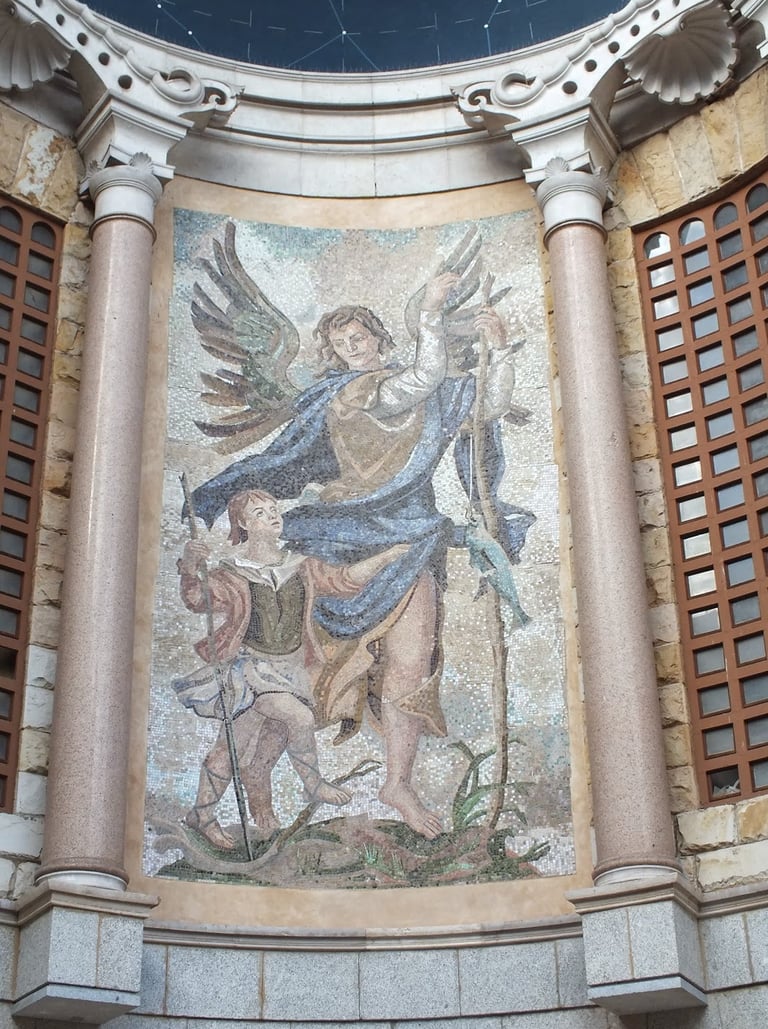
The five drawings rendered as mosaics correspond to the Archangels Saint Raphael and Saint Michael, and the remaining three to the Evangelists (John, Luke and Matthew); that of Saint Mark was left unexecuted for unknown reasons.
In this respect it should be made clear that the initial commission for the mosaics for the six exterior niches of the chapel of the Universidad Laboral was given to Joaquín Valverde, and in 1948 he undertook the cartoons now deposited in the Museo de la Ciudad de Carmona, which show that Valverde practised the art of the mural in a remarkable way. However, these cartoons measure 248 x 148 cm, which leads us to conclude that they were not the ones used for the mosaics later made by the master Padrós, since the finished and installed mosaics measure 380 x 300 cm for the two Archangels and 400 x 310 cm for the other designs. We therefore presume that Padrós needed to make new full-size, reversed drawings in order to execute these mosaics, which were installed from June 1957 onwards.


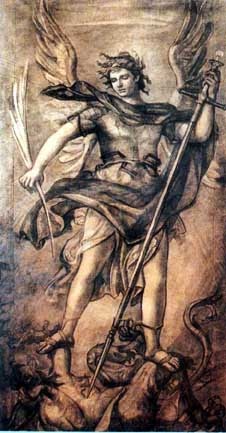

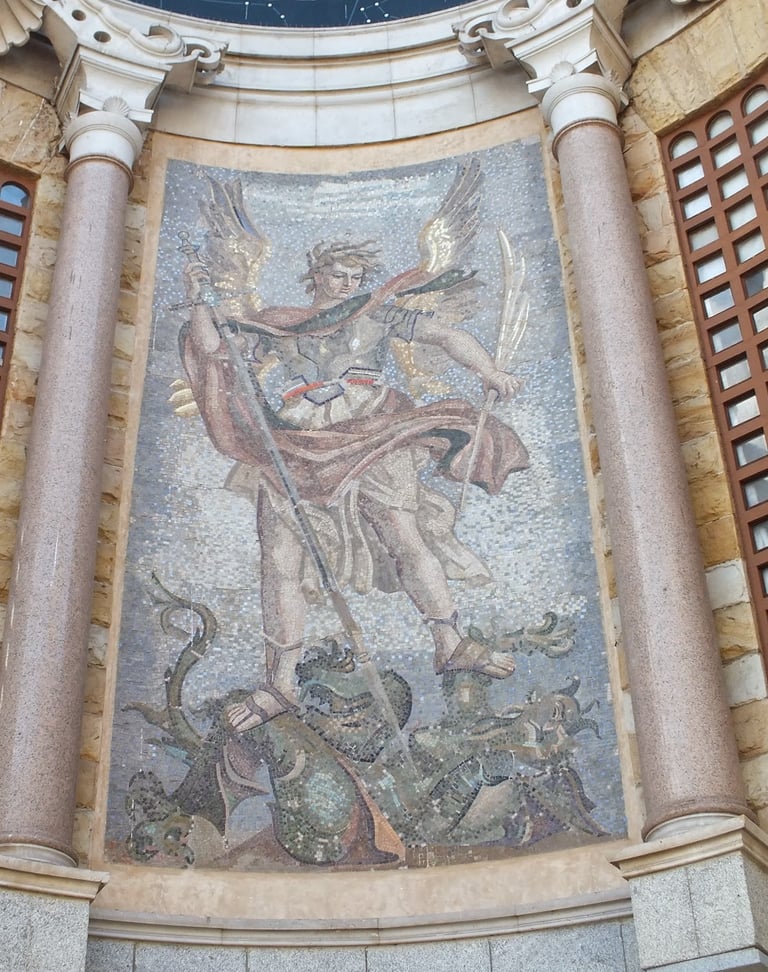

SAINT MICHAEL THE ARCHANGEL FIGHTING THE DRAGON


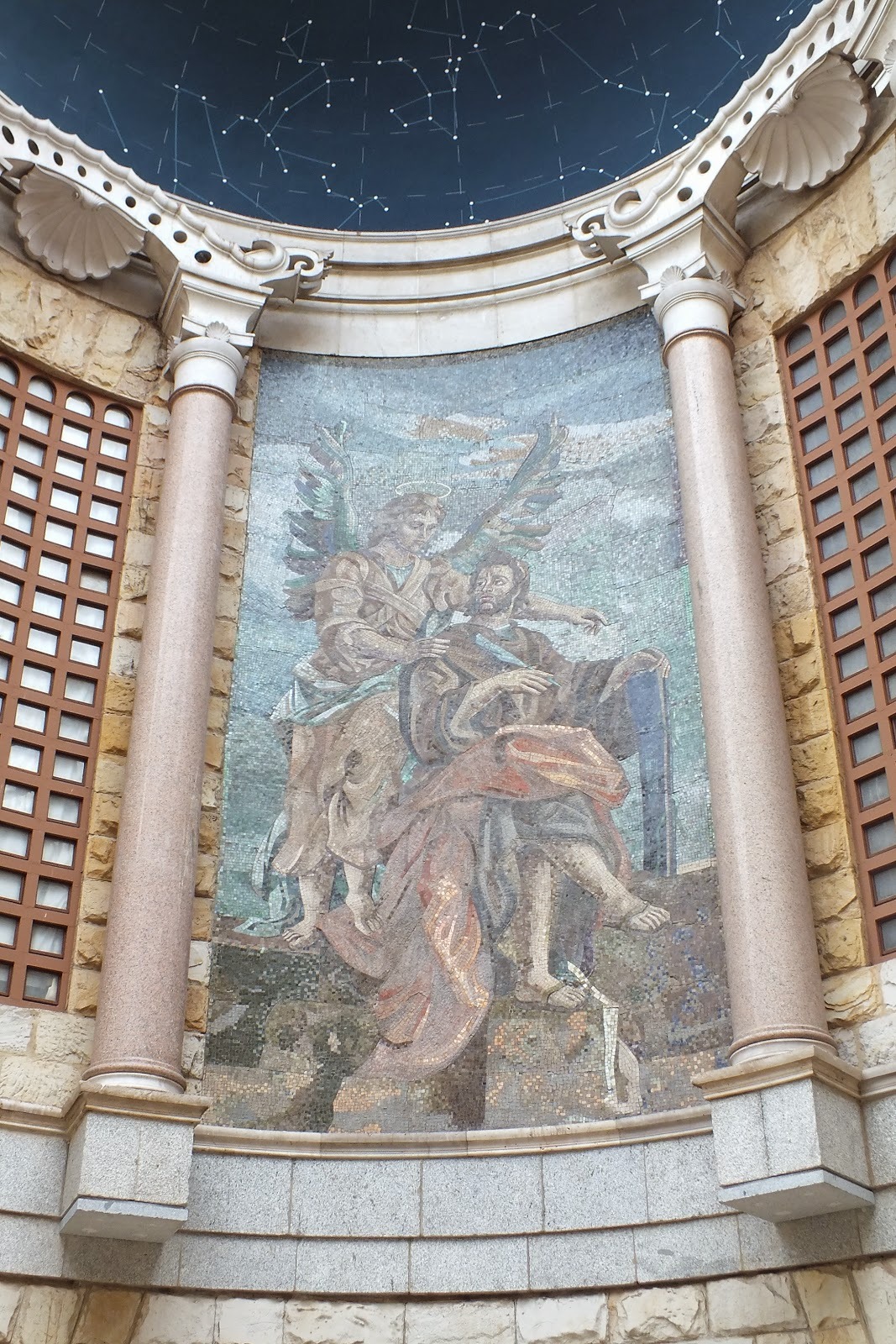
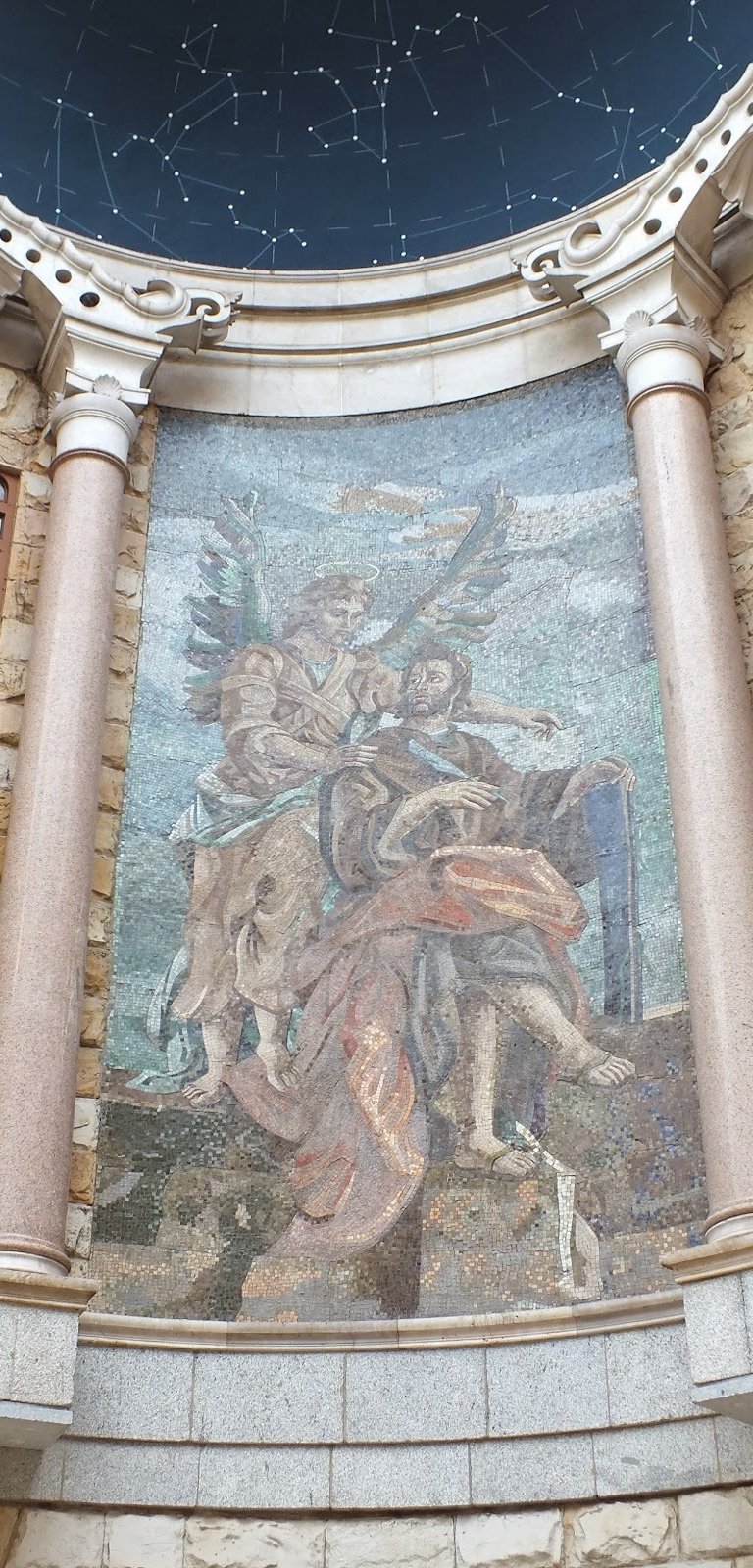
Saint Matthew the Evangelist, accompanied by an angel
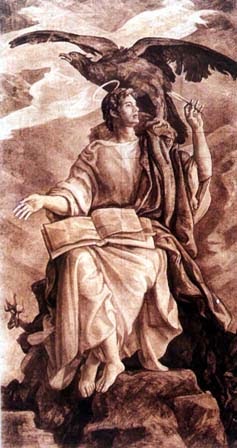


Saint John the Evangelist, symbolically represented by the eagle
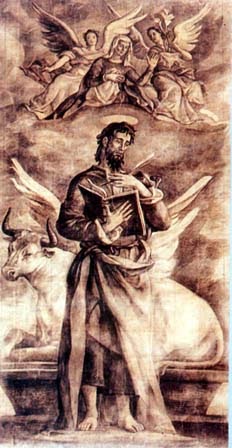

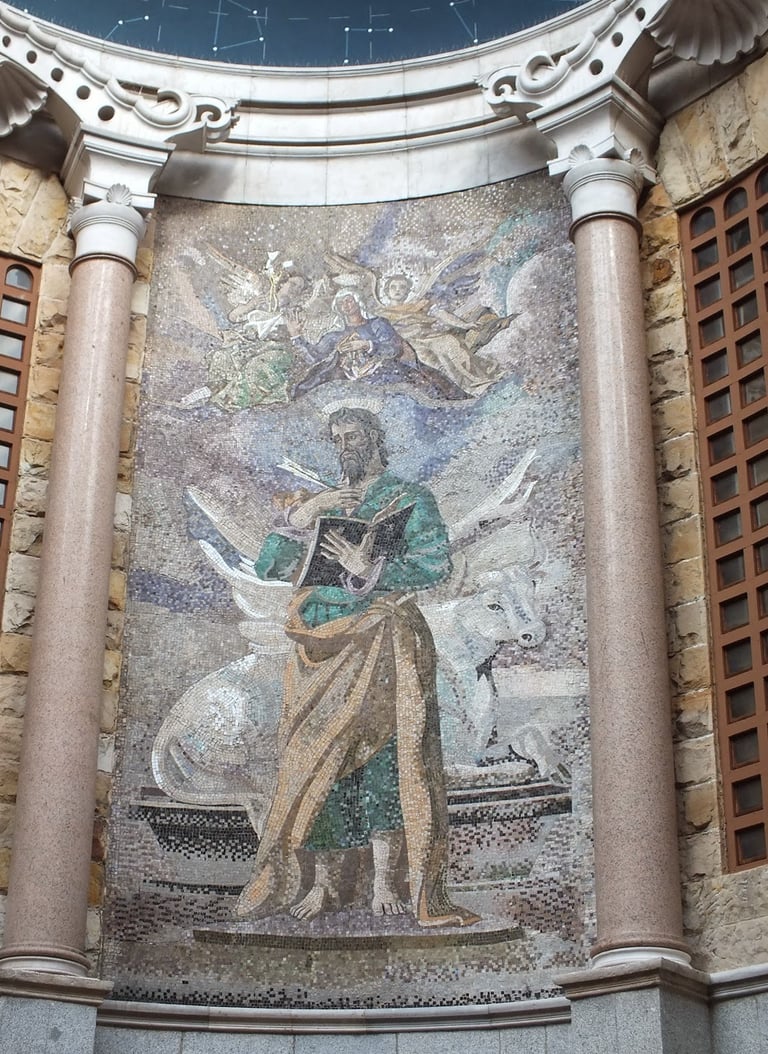

Saint Luke the Evangelist, standing with the book of the Gospel
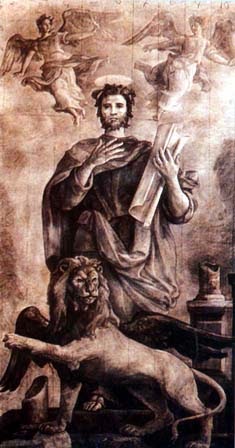


Saint Mark the Evangelist
The Archangel Saint Raphael guiding Tobias
Cartoon, 248 x 148 cm, in the Museo de Carmona
We know from documentary evidence that this unexecuted mural reached the Laboral in June 1957; to this day it is not known why it was not installed, nor is it known where this mosaic is.
Cartoon, 248 x 148 cm, in the Museo de Carmona
Cartoon, 248 x 148 cm, in the Museo de Carmona
Mosaic executed by Santiago Padrós, 380 x 300 cm
Mosaic executed by Santiago Padrós, 380 x 300 cm
Cartoon, 248 x 148 cm, in the Museo de Carmona
Cartoon, 248 x 148 cm, in the Museo de Carmona
Mosaic executed by Santiago Padrós, 400 x 310 cm
Cartoon, 248 x 148 cm, in the Museo de Carmona
Mosaic executed by Santiago Padrós, 400 x 310 cm
Unexecuted mural
Mosaic executed by Santiago Padrós, 400 x 310 cm
Rafael Morán Rumoroso
info@universidad-laboral-gijon.es

